Fun on the dark side

http://www.the-tls.co.uk/tls/reviews/other_categories/article1279157.ece

AIDAN FOSTER-CARTER

Victor Cha
THE IMPOSSIBLE STATE
North Korea, past and future
530pp. Bodley Head. £25.
978 1 84792 235 9

John Everard
ONLY BEAUTIFUL, PLEASE
A British diplomat in North Korea
260pp. Shorenstein Asia-Pacific Research Center. Paperback, £12.99 (US $18.95).
978 1 931368 25 4

Blaine Harden
ESCAPE FROM CAMP 14
One man’s remarkable odyssey From North Korea to freedom in the West
242pp. Pan Macmillan. Paperback, £8.99.
978 0 330 51954 0 US: Penguin. $15.978 0 14 312291 3

Johannes Schonherr
NORTH KOREAN CINEMA
A history
215pp. McFarland. Paperback, £63.50 (US $75).
978 0 7864 6526 2

Andrei Lankov
THE REAL NORTH KOREA
Life and politics in the failed Stalinist utopia
283pp. Oxford University Press. £16.99 (US $27.95).
978 019 996429 1

A now familiar satellite image shows the Korean peninsula at night. The South is ablaze with light, as are nearby Japan and China. The North, by contrast, is plunged in darkness but for a single blob: the capital Pyongyang, its monuments more brightly lit than residents’ homes, (North Korea has other large cities, but they show up only as the faintest of pinpricks.) You can feel the metaphor coming. The government of the Democratic People’s Republic of Korea (DPRK, its official name) keeps its citizens in the dark, not just literally – electricity is in chronically short supply – but by blocking all influences from outside, including the internet. In the other direction it is a different picture. We know far more about North Korea than formerly, yet pools of dark ness remain. Politics is one such, not least the thirty something young man who now rules the DPRK, and who earlier this year was cheerfully threatening all and sundry with pre-emptive nuclear strikes.

Until a decade ago, Kim Jong Un was not even known to exist, despite years of schooling in Switzerland; were our spies asleep? Kim Jong 11, son and successor to the DPRK’s founding leader Kim II Sung, was thought to have two sons of his own. In 2003 a Japanese who calls himself Kenji Fujimoto published a memoir, claiming to have been Kim Jong Il’s sushi chef and con¬fidant for over a decade. His tales of court life in Pyongyang – nude dancing girls (no touching), dog soup on Sundays and more – included the first mention of a hitherto unknown third son, said to be hot-headed and his father’s favourite. Right on both counts, it appears.

Fujimoto feared for his life after these revelations. Yet last July he was invited back by Kim Jong Un, who seems to share his father’s view that there is no such thing as bad publicity. In 2001 Kim Jong II had told Konstantin Pulikovsky, sent by Vladimir Putin to escort him on a leisurely and luxurious journey to Moscow aboard Kim’s personal train: “I am the object of crit¬icism around the world. But I think that since I am being discussed, then I am on the right track”. Like Fujimoto, Pulikovsky spilled the beans. Live lobster was flown in daily as the caravan crossed Siberia. There were silver chopsticks, fine French wines, lusty choruses of old Soviet songs, and maidens “of the utmost beauty and intelligence” (clothed, indeed uniformed).

Pulikovsky’s account, Orient Express, remains untranslated. The same goes for Fujimoto, now with three books out, and the important memoirs of Song Hye Rang, aunt of Kim Jong IPs disinherited and off-message eldest son Kim Jong Nam: formerly of Macau, now in hiding. Even the gripping tale by South Korea’s Burton and Taylor, the film director Shin Sang Ok and his on- off spouse the actress Choi Eun Hee, of their 1978 kidnapping – or was it? – on Kim Jong Il’s orders, life in the North (from jail to pal¬ace) and escape in 1986, has never appeared in English.

This is surprising. Nowadays books on North Korea pour from the presses: written mostly by outsiders who have never lived there, and occasionally never even been there. In this inspect the light map of the peninsula is reversed. Oddly, there are far fewer non-specialist works on the South: a fascinating and dynamic land, much easier to visit and study. Daniel Tudor, the Economist’s Seoul correspondent, recently published the first general introduction to South Korea to appear for some time; calling it, somewhat unexpectedly, The Impossible Country.

In a coincidence both authors may regret, Victor Cha chose the same adjective for the other Korea, where it fits much better. An academic who served in George W. Bush’s White House, Cha has written what his publisher brashly bills as “the definitive account of North Korea”. There can be no such thing; but this is a serviceable intro¬duction, from a conventional US viewpoint, to the tangles of what an earlier age would have called “the Korean question”. It will disappoint those hoping for an inside view of the battles between hawks and doves that rent the Bush administration, undermining any coherent policy. Cha’s defensive account is less informative than works with no axe to grind, such as Mike Chinoy’s Meltdown (2008).

His virtues include a crisp chapter, “Five Bad Decisions”, on how the North’s economy lost its initial lead over the South (impossible to imagine now) and became today’s malnourished basket case. On policy, Cha rightly urges the need for the US and South Korea to coordinate their contingency planning with China. Beijing has not been keen, but this may change as it loses patience with Kim Jong Un’s antics. The final chapter, “The End Is Near”, predicts that the DPRK will collapse under the weight of its contradictions, and soon. Such forecasts have been heard for two decades, but North Korea has defied them thus far. If it survives till 2020, it will surpass the USSR as the longest-lived Communist (if that is the word) state. Its second hereditary succession looks smooth, yet in May a defence minister was replaced for the third time in a year. The armed forces thrived under Kim Jong II; his son and the Party are now reining them in. Ructions are possible, but Cha’s hopes for something akin to the Arab Spring in the DPRK seem optimistic.

Thousands of Westerners visit North Korea each year; a dozen firms compete to take them. (None pulled out during the recent tensions, though they had some cancellations.) Far fewer Westerners live there. Those who have written about the experi¬ence include two Englishmen, Andrew Hol¬loway and Michael Harrold, whose job was to correct the English in translations of works by the Leaders. Recently the Swiss Felix Abt self-published a book, available online, A Capitalist in North Korea, about his years in the country between 2002 and 2009. It would be good too to have the obser¬vations of aid workers, whom since 1995 North Korea has grudgingly let in, as it needs their help; but none so far seems to have gone into print.

John Everard wishes they would, so as “to correct the assertions of some who have writ¬ten at length and stridently … on the basis of very limited knowledge”. He himself spent two years (2006-08) in North Korea as Her Majesty’s Ambassador; previous postings had included inaugurating the Brit¬ish embassy in Belarus. UK-DPRK diplo¬matic relations date only from 2000, but already Britain has had six chefs de mission in Pyongyang. James Hoare opened the embassy, writing about this and more in North Korea in the 21st Century (2005, with Susan Pares). Now at SOAS, last year the tireless Dr Hoare produced both a historical dictionary of the DPRK and an edited three volume article collection on both Koreas.

As his evocative title suggests, Everard brings a keen ear and a fresh perspective to an often stale field. An eager cyclist, he could venture off the beaten track. Pedalling a scenic byway to the port of Nampo, “on my way back men appeared on bridges along my route telling me to take the main road”. (The plural suggests he ignored them.) He recounts some surprisingly frank conversations with North Koreans whose identity he rightly disguises, calling them all “she”, which adds a frisson; most were surely he. These were not the woman or man in the street but what he precisely pinpoints as “the outer elite”: those with “stable but not top-level jobs”.

In writers such as Abt, a laudable urge lo correct one-dimensional caricatures teeters into the trap of apologetics. This Everard avoids. With rare balance, he combines full awareness of the nuances and depth of the society with robust censure of the regime. Of course North Koreans are human beings, not robots; whoever denied it? But the DPRK is still a ghastly place nonpareil. He dedicates Only Beautiful, Please “to the people of North Korea, who deserve better”.

The heart of darkness is a vast gulag, where up to 200,000 innocents suffer unspeakably and often indefinitely. This used to be dark in another sense almost no details leaked out. Now the camps can be seen on Google Earth, and many reports have detailed their awful abuses. Some victims have written memoirs, the best-known being Kang Choi Hwan’s Aquariums of Pyongyang (2000). Kang was nine when his whole family was sent to Yodok camp after his grandfather, a Kyoto businessman who answered the fatherland’s call to build socialism – he even brought his Volvo – complained once too often. About 90,000 Koreans left Japan for North Korea, never to return; many were never heard of again. This thread in the DPRK tapestry of misery was the subject of Tessa Morris- Suzuki’s poignant Exodus to North Korea (2007).

Shin Dong Hyuk can trump Kang: he was born in the gulag. Near in age to Kim Jong Un, he recounts a Hobbesian life of constant, vicious, numbing cruelty. Shin even betrayed his own mother and brother for plotting to escape, and watched their executions. Almost as appalling is that few cared in South Korea, to which he miraculously escaped; his first book flopped. It look an American journalist, Blaine Harden, lo make Shin’s shocking story a global hit m twenty-four languages. All credit to him, though it seems strange not to credit Shin as co-author of Escape from Camp II: not even a “with”. The UN Human Rights Council recently set up a commission of inquiry into DPRK human rights abuses; it will report next March. No doubt the regime will continue brazenly to deny everything. For its interlocutors, the dilemma is what to prioritize. If the main task is to curb North Korea’s nuclear and missile activities, human rights tend to be passed over.

Most North Koreans avoid the gulag, but all go to the movies: a softer form of social control. Kim Jong 11 was a film fanatic; his works include On the Art of the Cinema (1973). Aware that quality was poor, Kim drafted in the Southern director Shin Sang Ok to improve things. Johannes Schönherr, whose North Korean Cinema is the first book in English on its subject, doubts if Shin was kidnapped. Schönherr’s own journey has been picaresque. He is a former East German grave-digger, expelled from the GDR in 1983. His Trashfilm Roadshows (2002) was a romp through the transgressive or bizarre; its index has “Woman Warrior of Koryo” between “Whoregasm” and “Zombie Hunger”. Blagging his way to a film festival in Pyongyang, he found his true metier. Still freelance, he now lives in Japan. Full of stills (all in black and while). North Korean Cinema is eye opening and a word rarely used of the DPRK — fun. Unencumbered by theory, this is a rich narrative history from the 1940s in the present. North Korea’s latest films revert to pre-Shin leadenness: no match for the slickness of South Korean soaps and other foreign fare, which circulate widely on DVD or memory stick the latter easier to hide if the police call.

Such key social changes are well documented in The Real North Korea. Andrei Lankov is a phenomenon. Born in Leningrad, he studied in Pyongyang and is now a professor in Seoul. A historian who has used Soviet archives to write two books (so far) on the DPRK’s early political history, he is also a prolific commentator. Besides writing many an op-ed, he has two long-running columns in the Korea Times, on the dawn of modern Korea and on the North, each already anthologized in book form. Some of the thirteen boxes studding the text of this new book are from such columns, though that is not mentioned. This is the best all-round account of North Korea yet. Its many virtues include apt detail, dry wit, a sure analytical touch, and refusal to preach. Lankov is insightful too on the South, such as the contortions of its leftists. Still fixated on their own long gone dictators (pussycats compared to the Kims), some find virtue in the North: at least it hosts no foreign troops. Dividing a nation also twists minds.

What can be done? Hawks and doves both err. As Lankov puts it, the sticks are not big enough and the carrots not sweet enough. Engagement is better than sanctions for weakening the regime, but North Korea can last a while yet before the inevitable crisis. That could arise in several ways, but whatever happens a soft landing is “not very probable”. Not quite Hilaire Belloc’s “They answered as they look their fees, There is no cure for this disease”; but small comfort for ideologues, certain that being either tougher or kinder to Kim Jong Un will do the trick.
Posted in Aidan Foster-Carter, Art and Culture, Times (UK) | Leave a comment

Ginseng, bear bile: NKoreans look to old cures

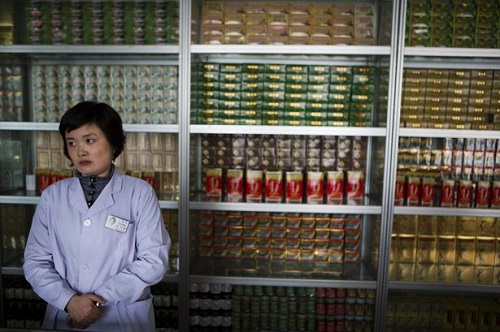
In this Feb. 21, 2013 photo, a pharmacist waits for customers at the Man Nyon Pharmacy, the nation's largest dispensary of traditional "Koryo" medicine, in Pyongyang, North Korea. North Korea began marrying traditional medicine with modern practice in the 1950s after the Korean War. (AP Photo/David Guttenfelder)

In this Feb. 21, 2013 photo, a pharmacist waits for customers at the Man Nyon Pharmacy, the nation’s largest dispensary of traditional “Koryo” medicine, in Pyongyang, North Korea. North Korea began marrying traditional medicine with modern practice in the 1950s after the Korean War. (AP Photo/David Guttenfelder)

The Associated Press http://www.ajc.com/ap/ap/health/ginseng-bear-bile-nkoreans-look-to-old-cures/nXgpZ/

PYONGYANG, North Korea — The Man Nyon Pharmacy is lined with rows of colorful packages containing everything from dried bear bile and deer antler elixir to tiger bone paste and ginseng. But the ancient “Koryo” medicine provided at this popular dispensary isn’t just for minor aches and pains.

It has been integrated into the health system from the smallest village clinic all the way up to the nicest showcase hospitals in the privileged capital of Pyongyang. Both modern and traditional styles of healing have long been uniquely intertwined nationwide with doctors from both schools working in tandem under one roof.

North Korean physicians say many patients prefer traditional medicine to the Western kind, but it’s difficult to determine the true situation in this closed and impoverished society where access is limited. Defectors, foreign aid workers and North Koreans agree that many Western drugs are scarce and say villagers still forage for plants in some areas to make their own herbal concoctions.
With the U.N. Security Council imposing its toughest-ever sanctions following North Korea’s third nuclear test in February, patients may become even more dependent on these home-grown remedies in a country of 24 million people where government health spending ranks among the world’s lowest.

“Doctors are more interested in Koryo medicine rather than Western medicine because they can get it more easily,” said Ri Hye Yong, who manages the frigid concrete pharmacy opened by the government nearly three decades ago. “It’s much cheaper.”

The latest restrictions are meant to squeeze new young leader Kim Jong Un and the ruling class by clamping down on access to foreign travel and luxury goods. North Korea has responded with tirades that include threatening nuclear attacks against the U.S. and its allies.

The resolution is not supposed to block donor aid to those who need it most, including the two-thirds of the population who don’t have enough to eat. But foreign aid workers say years of limitations have created a maze of red tape and approvals needed to ship in medical supplies and equipment. Some countries refuse to process payments for anything involving North Korea because of restrictions placed on banks, while some foreign companies and organizations simply do not want to be involved once they learn where the materials are headed. But once the goods arrive, they say the process becomes fairly simple.
“Even though the imposed sanctions clearly exclude humanitarian assistance, a negative impact on the levels of humanitarian funding has been experienced,” the U.N. Resident Coordinator’s Office in Pyongyang said in a statement April 29, adding nearly three-quarters of the $147 million needed this year has not been received.

The World Health Organization is lacking an estimated 60 percent of the drugs it needs for at-risk kids and pregnant women, while the U.N. Children’s Fund is struggling to get vaccines and medicines to prevent the biggest killer diseases among children, it said.

In addition, the WHO says the process of importing essential equipment and medicine has also grown lengthy at all levels, and those involved have become over cautious in clearing materials to ensure they could not be classified as dual purpose or luxurious items.

International efforts to help boost the country’s ability to produce its own vaccines and medicines were earlier affected when some technology and seed microbes were halted over concerns they could potentially be used by Pyongyang for malicious purposes, WHO said.

Despite these challenges, it’s difficult to understand the full picture within North Korea where outsiders are banned from traveling freely and data are lacking or unreliable. Suspicion of the outside world is reinforced by huge hospital propaganda paintings depicting Americans and Japanese as the country’s “sworn enemies.”

Jang Jun Sang, a department director at the Ministry of Public Health, said in an interview in February that sanctions have cut imports of medical equipment and supplies.

But he said North Korea was used to sanctions. “If we receive medical aid, that’s good,” he said. “But if we don’t, that’s fine, too. We’re not worried.”
North Korean factories have limited ability to produce pharmaceuticals, and many rural clinics lack electricity, running water and heating. By the government’s own account, more than 80 percent of village clinics suffer from “chronic shortages of medicines and supplies at all levels of the system.”

According to defectors such as Kwon Hyo-jin, some drugs are smuggled in from neighboring China and marketed while others are taken from hospitals and sold illegally. All health care is supposed to be free in North Korea.

Kwon said he was forced to buy an IV drip as well as antibiotics, painkillers, and other Western medicines from China after suffering bouts of food poisoning and later while hospitalized with a broken leg in 1997 in the northeastern city of Chongjin. He recalled a hospital bed swarming with lice and a tap that spewed muddy water and worms.

The 52-year-old, who defected to South Korea in 2009 and now works at the Seoul-based Committee for the Democratization of North Korea, said he tried to avoid hospitals in the North altogether. Instead, he visited Koryo doctors usually for upset stomach, back pain and insomnia.

Traditional medicine is cheaper and easier to find. Walls of tiny wooden drawers similar to a library card catalog fill one vast room at Pyongyang Medical College, each containing hundreds of tiny paper triangles stuffed with dried herbs.

“I think Koryo medicine has mysterious characteristics,” said Dr. Ryu Hwan Su, the hospital’s deputy chief, who proudly displayed a jar filled with a fat ginseng root believed to be more than a century old. “It heals illnesses that Western medicines can’t treat.”

Traditional medicine is used widely in many Asian countries, including China, Japan and South Korea, where there is no shortage of modern treatment and equipment. And while scientific research regarding the benefits of some age-old treatments is lacking, therapies such as massage and acupuncture — which can also serve as a local anesthetic — are now widely used in the West.

Some North Korean clinics have their own greenhouses, and herbs are harvested every year in the wild to be processed into teas and other concoctions. The government says Koryo medicine is used to treat more than half the patients in rural clinics. But shortages exist too.

Patients are often prescribed a simple herb they are expected to get themselves, said Dr. Byungmook Lim, a professor at South Korea’s Pusan National University School of Korean Medicine, who co-authored a study comparing traditional medicine in the two Koreas.

The country began marrying traditional medicine with modern practice in the 1950s after the Korean War. Doctors were given training in Koryo medicine and each hospital was set up with a department devoted to it, with prevention as the guiding concept behind the socialized health plan. Unlike in other Asian countries where the two practices are typically kept separate, traditional practitioners in North Korea can prescribe modern drugs and assist during surgeries, while Western doctors can use Koryo treatments.

“We kept talking to each other and consulting each other,” said Kim Jie-eun, who graduated from a Koryo school with some modern training, and practiced in North Korea as a pediatrician and internal medicine doctor before defecting in 1999. She now runs a traditional clinic in Bucheon, South Korea, and recalls that even acupuncture needles were reused in the North. She said frequent shortages of antibiotics meant high-level officials got treated first, while ordinary patients struggled to find medicines.

“I was really angry. They were the same human beings,” she said. “How this could happen?”

But she believes combining the two types of treatment was actually better for patients. She said Koryo medicine — taken from the old name for Korea — was often used alone or in combination with Western drugs to treat a variety of health problems including stroke, hepatitis, high blood pressure, kidney disorders and diabetes.

And it’s still done today. At the new Breast Cancer Research Center at the Pyongyang Maternity Hospital, a showcase institution where The Associated Press was recently taken on a tour, patient Ri Jong Suk said she was set to be released after having a mastectomy and reconstruction surgery.

She said during her one-month stay she was given Western medicine along with Koryo treatment, including massage and acupuncture, to help strengthen her immune system, decrease swelling and circulate blood after surgery. The Health Ministry also cites hot springs, mineral water and mud among successful treatments. Cupping is another popular therapy believed to stimulate blood flow by using heated glass jars to create a vacuum on the skin.

Many of these healing techniques are also commonly used in South Korea, which is rooted in the same ancient traditional medicine as its northern counterpart. But in that country, modern and traditional medicines typically operate independently, each with its own licensing and education system.

North Korea was once dependent on the Soviet Union to keep its medical system running. But after the collapse of its patron, economic crisis and famine followed in the 1990s and Pyongyang became increasingly isolated amid growing nuclear ambitions.

The government spent nearly $9 billion on defense in 2009, according to the South Korean state-run Korea Institute of Defense Analyses. Pyongyang says it spends $900 million a year on health, but one WHO estimate put government spending at less than $1 per person in 2006. That’s less than $25 million and among the world’s lowest, though other reports have placed it higher.

Outside the capital, donors provide some 70 percent of the most needed drugs, which are believed to reach less than half of those in need, according to the WHO.

Meanwhile, the U.S. has accused North Korea of manufacturing and trafficking illegal drugs, such as opium and methamphetamine. It also believes the government is likely involved in peddling fake Western pills, such as Viagra.
Koryo medicine was thrust into the international spotlight when five members of the North Korean female soccer team tested positive for steroids at the 2011 Women’s World Cup in Germany.

North Korean officials said the players took traditional musk deer gland as therapy after they were struck by lightning during training. Soccer authorities said they had never seen the substance found in the women’s systems, and the squad was sent home in disgrace.

Animal products are a major part of Koryo medicine, along with various traditional healing used in other Asian countries. Deer antler is used to strengthen the immune system, tiger bone to relieve fevers, and bear bile mixed into hot water and sipped to relieve pain and remove toxins. Some concoctions are believed to enhance virility.

Some Asian countries ban bear bile because the method of extraction is considered inhumane. Asked where North Korea gets its bile, pharmacist Ri said it came from the zoo where about 50 bears are housed. AP couldn’t verify this practice and spotted only one bear inside an enclosure at the national zoo in Pyongyang.

“Koryo medicine seems to have somehow served the population, which is in desperate need of treatment amid difficulties in health, while the Western health delivery system has been badly affected,” Lim, the South Korean professor, and colleagues wrote in the 2009 paper published in the Journal of Alternative and Complementary Medicine. It was based on a review of North Korean textbooks and medical journals as well as interviews with defectors who had studied the practice.

Still, much remains a mystery. North Korea’s isolation means little has been published on Koryo medicine or its integration with modern techniques, leaving safety and efficacy concerns largely unanswered.

But some say being cut off from the outside world for so long may have led to the discovery of valid remedies. The Chinese found a vital malaria treatment in a ragweed-like plant nearly four decades ago at a time when it had minimal contact with the West.

“They are somehow surviving through such harsh conditions,” said Dr. Jongbae Park, director of Asian medicine and acupuncture research at the University of North Carolina, who co-authored the Koryo medicine study.

“A lot of new ideas and new findings are coming from desperate efforts through challenges, so I am rather hoping that they would have reserved a new finding that the outside world cannot think of, particularly in coping with the main diseases.”
____
Associated Press writers Hyung-jin Kim in Seoul, South Korea, and Edith M. Lederer at the United Nations contributed to this report.
____
Follow Asia Medical Writer Margie Mason on Twitter: twitter.com/MargieMasonAP
Copyright The Associated Press

Posted in Associated Press | Tagged | Leave a comment

North Korean ‘court poet’ to publish memoir

http://www.theguardian.com/books/2013/may/01/jang-jin-sung-north-korea-insider-memoir

He’s seen Kim Jong-il cry – Jang Jin-sung’s story of life inside the totalitarian state’s propaganda machine could be electric

By Daniel Kalder

North Korean poet Jang Jin-sung, speaking at London's Poetry Parnassus. Photograph: Sylvia Hui/Associated Press

North Korean poet Jang Jin-sung, speaking at London’s Poetry Parnassus. Photograph: Sylvia Hui/Associated Press

Each London Book Fair brings breathless announcements of mega deals and amazing new books – although how many live up to expectations is another matter. This year however a news item appeared that sounds like a genuine event. Rider Publishing, an imprint of Ebury at Random House, acquired rights to Crossing the Border, a memoir by Jang Jin-sung – former “court poet” to Kim Jong-il, and will publish next spring.

Of course, North Korea is hot right now, courtesy of Kim Jong-un’s statements about nuclear war. Indeed, Adam Johnson can probably thank Kim for the Pulitzer he won for his North Korea-set novel The Orphan Master’s Son. Meanwhile, BBC reporter John Sweeney – not content with clashing with the LSE with his documentary on the hermit kingdom – has also written a (not yet published) book, Zombie Nation. Both authors made precisely one trip each to the country.

Of accounts of North Korea written by North Koreans, Kang Chol-hwan’s The Aquariums of Pyongyang is probably the most famous. A harrowing description of 10 years in a prison camp, it is a North Korean equivalent to the works of Solzhenitsyn or Varlam Shalamov. But Jang Jin-sung’s book is something even rarer – an exposé of the workings of a totalitarian state by a member of its inner circle.

According to his agent, Marysia Juszczakiewicz, Jang Jin-sung escaped North Korea in 2004, crossing the Tumen River into China. Following his arrival in South Korea, Jang worked in the National Security Research Institute and published his first book of poetry, I Am Selling My Daughter For 100 Won, which details the horror of life in North Korea; it sold more than 80,000 copies. Today he is editor-in-chief of New Focus, “the leading website on North Korea by north Koreans in exile” .

Before all that, however, he led a very different life. Says Juszczakiewicz: “Jang was born into a bloodline of impeccable revolutionary credentials, he trained as a classical pianist before studying literature at Kim Il-sung University. He went on to join the Central Committee of the North Korean Writers’ Union and worked in the Ministry of Reunification, where he was responsible for creating and disseminating propaganda throughout both North and South Korea. During one period, he helped develop the founding myth of North Korea as having begun on 15 April, 1912, with the sinking of the Titanic in the west and the rising of the sun – Kim Il-sung – in the east.”

Jang was so trusted that he met Kim Jong-il twice. The first time, Jang explained in an interview with the BBC last January, “I was overwhelmed and full of emotion. But at the same time I thought the image I had received of him – through brainwashing – was very different to how he appeared in person.” Kim gave the poet an gold Rolex worth $11,000 (£7,000) and granted him the “sacred immunity” that only the microscopic minority who spent 20 minutes in the presence of the god-dictator received. Now Jang could not be prosecuted without special permission from on high. At the second meeting, “We sat at a performance together, and he kept on crying while he watched it. I felt his tears represented his yearning to become a human being, to become an ordinary person.”

Jang could not reconcile his lifestyle with the suffering he saw around him. He wrote poetry critical of the regime while circulating banned South Korean books. Soon he was obliged to flee.

Jang views his memoir as a weapon against tyranny. He met his translator Shirley Lee last year at the Poetry Parnassus at the Olympics, and says: “The London Olympics was the turning point for me of looking internationally and of the power of literature to tell the truth. NK (sic) may have nuclear weapons, but we have the media.”

Lee stresses the literary quality of Crossing the Border and insists that, his training in propaganda notwithstanding, Jang is a real poet: “The original Korean book is titled ‘Crossing the river with poetry in my heart’ – Jang escaped with no possessions but the manuscript of his poetry collection depicting life in North Korea. In this way, his poems are the memories he brought with him out of the country. They are the record of reality through the individual’s eyes, written in a country where no record of reality may be made except through the ruling party’s eyes. Parts of the book are a rendition in prose of snapshots he captured with his poetry in North Korea; if the poetry is snapshots, the memoir is a movie.”

Posted in Guardian | Tagged | Leave a comment

From poor island boy to multi-business entrepreneur, Korean expat plans for more

http://english.yonhapnews.co.kr/news/2013/02/28/0200000000AEN20130228003800315.HTML
By Cho Jae-eun
Contributing writer

LONDON, March 5 (Yonhap) — It’s not every day that you get a pair of iconic, reclusive, but immaculately tailored artists peering through your windows. But when precisely that happened to Lee Ki-chul, at his London store Hurwundeki, the Korean expat-turned-entrepreneur didn’t bat an eye.

“A surprised customer came to me one day, saying that (renowned British artists) Gilbert & George were hanging onto the windowsill, glancing at the shop. They eventually came in and complimented the interior of the shop, especially the stripped walls,” says Lee, at his hair salocafe, near Bethnal Green Station in East London.

“After that day, the pair came almost every day and we all became friends. (Model) Kate Moss and (rock singer) Pete Doherty often came to the clothes shop. It received so much attention when I first opened, it was beyond anything I had ever imagined.”

Lee Ki-chul

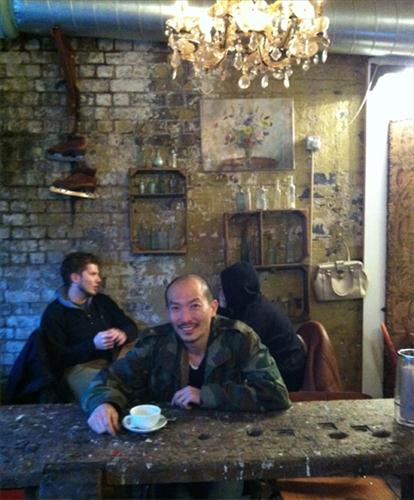
Lee Ki-chul poses inside his shop, Hurwundeki, in East London, with a cup of coffee he brewed himself (Photo: Cho Jae-eun)

Sipping a cup of fresh coffee he has brewed, the 45-year-old entrepreneur points to a wooly cape hanging on the wall, swearing that it’s a vintage item from the Napoleonic Era. The cafe portion is packed with uber trendy accessories: stuffed animals, ruggedly cut wooden tables, antique chandeliers — and a sofa wrapped in saekdong (colors used in traditional Korean costume) patchworks.

Hurwundeki, meaning “hair” in the dialect from the Korean island of Jeju, seems to be an amalgamation of life experiences that have influenced Lee — memories of his life growing up on the island, times as a 20-something hair salon owner in Seoul, and a period when Lee was a vintage-loving arts student in London, rummaging through flea markets in search of hidden treasures.

“Now all the cafes in London have these stripped down, unfinished walls, but what influenced me to do this to my walls back when I opened the shop was a childhood ‘trauma’ of sorts,” Lee explains.

“My family didn’t have enough money to paint the walls in our house and I was so embarrassed that I never invited any of my friends to come over. I guess in a way, stripping down the paint in my shop was a sort of therapy for me,” he says, laughing.

A haircut at Hurwundeki

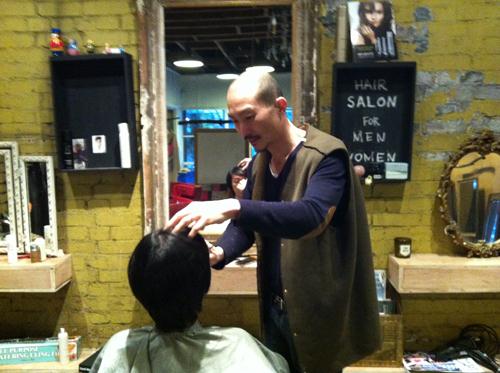
A haircut at Hurwundeki

As a little boy growing up in Andeok, Jeju, Lee says that he felt trapped. “I grew up in the depths of the countryside in Jeju. I felt like the kids I grew up with didn’t dare to dream. It was as if we weren’t allowed to have ambitious dreams and go off and be successful,” he says.

“But I wanted to see the world. I would daydream about giving speeches in some big auditorium, with the U.S. president in attendance.”

Soon after high school, Lee left immediately to go live in Seoul, and at his sister’s insistence, became a hair stylist.

“She kept telling me I had a natural talent for hair. I saw it as my escape from Jeju.”

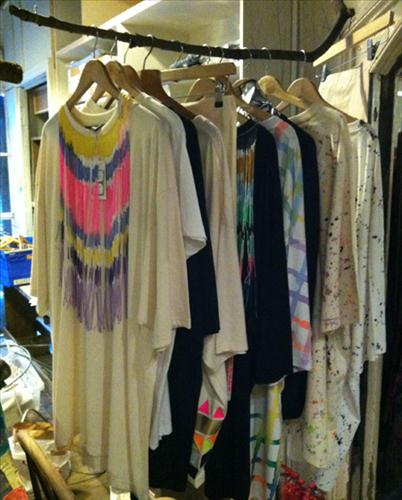
Clothing at Hurwundeki

Aside from cutting hair, Lee sells clothing by up-and-coming designers at Hurwundeki.

By his late 20s, Lee, now far from his “suffocating” hometown, had a decade’s worth of success being a hair stylist and salon owner in Seoul. This success moved him towards yet the bigger dream of making the Hurwundeki name global. In 2000, he decided to face up to his lifelong ambition — and ultimate fear — of opening a business in London.

“London was, and still is, an extremely important city to me,” he says, listing some British artists and designers like Vidal Sassoon and Alexander McQueen, whom he admired as a young man.

The feeling of being trapped started creeping up on him again in Seoul, as Lee felt himself grow tired of the uniformity of trends, of “looking at the same outfits on the streets, day-in-and-day-out.”
“But as much as I loved and looked up to London, it was also a source of great fear. If I failed in London, my creativity would never really be validated.”

After graduating from the Vidal Sassoon Academy, Lee made the bold move of opening Hurwundeki near Brick Lane, East London, in 2004. His innovative shop, merging hair, fashion and cafe culture, immediately enjoyed local media attention. By 2011, culture magazine Time Out named Hurwundeki one of its top 40 shops in London.

Lee admits that he has always been quite “gifted” in being entrepreneurial. As a student, his first taste of business in London came when he started selling shoes in Portobello Market that his sister bought from Dongdaemun Market in Seoul and sent to him.

With the money from selling these shoes and some money from his salon business in Korea, Lee opened store after store in London, after the first in 2004. By 2010, Lee owned four stores in London under the Hurwundeki name. “At the height of our popularity, the clothing store on Commercial Street had to close its doors so that customers could only enter one at a time,” says Lee.

The business’ rapid ascent, however, came to a grinding halt in the face of the global economic crisis. Forced to close down three of his four shops by 2011, Lee now operates the salon, cafe and clothing shop under one roof.

“The recession was a big hit in the fashion industry and my store, like all brands, suffered,” he says. “It’s hard sometimes. The other day, my wife (who helps around the shop) said to me, ‘I didn’t come to London to wash dishes.’ Any business worth its salt is going to have ups-and-downs. And my business will always be an ongoing process.”
In a strange twist of fate, Lee decided to go back to the place where, as a little boy, he had so wanted to escape from. In an attempt to push his business forward, Lee went back to his roots, opening a restaurant/cafe on Jeju last year named Osorok, which serves up organic dishes using home-grown vegetables Lee grows himself. He says the restaurant/cafe is the first move for the Hurwundeki brand to go global, and that he has been eyeing Beijing as his next destination.

He still misses Korean food, his parents and friends back home. But after 11 years in London, he admits it’s often difficult to readjust to the “Korean” way of doing things.

“I saw my service staff at Osorok being trained and was so shocked that they were expected to bow to customers at a 90 degree angle. It was quite disgusting actually,” he says, his forehead creasing into a frown. “I am not saying I am British but I just wish that the service mentality in Korea was more natural.”

This natural approach, Lee says, is important for him, in his belief that service or entrepreneurship shouldn’t be forced.

“I think customers recognize when service is coming from the heart. And you have to enjoy what you do to present this kind of attitude.

If you work for 14 hours a day but you don’t grow tired of what you do, other people will like what you are doing as well.”

Having dipped his toes into fashion, hair, interior design and food, Lee says he wants to focus more on hair in the future.

“Fashion and design are mature industries. There is not much I can add. However, the hair industry is still relatively young and there is much more room for innovation and improvement,” Lee says.

Regardless of the field of expertise however, Lee says that it is working and being creative that drives him every day.

“Like Yves Saint Laurent did, I want to work until the day I die.”

Posted in Yonhap | Leave a comment

The 18th Presidential Inaugural Address

“Opening a new Era of Hope”
http://english1.president.go.kr/activity/speeches.php?srh%5Bpage%5D=3&srh%5Bview_mode%5D=detail&srh%5Bseq%5D=2617&srh%5Bdetail_no%5D=1

Park-speech

My fellow Koreans and seven million fellow compatriots overseas,

As I take office as the 18th-term President of the Republic of Korea, I stand before you today determined to open a new era of hope.

I am profoundly grateful to the Korean people for entrusting this historic mission to me. I also thank President Lee Myung-bak, former Presidents, dignitaries who have come from abroad to celebrate this occasion, and other distinguished guests for their presence.

As President of the Republic of Korea, I will live up to the will of the people by achieving economic rejuvenation, the happiness of the people, and the flourishing of our culture.

I will do my utmost to building a Republic of Korea that is prosperous and where happiness is felt by all Koreans.

Fellow citizens,

The Republic of Korea as we know it today has been built on the blood, toil, and sweat of the people.

We have written a new history of extraordinary achievement combining industrialization and democratization based on the unwavering “can do” spirit of our people and matching resolve.

The Korean saga that is often referred to as the “Miracle on the Han River” was written on the heels of our citizens who worked tirelessly in the mines of Germany, in the torrid deserts of the Middle East, in factories and laboratories where the lights were never turned off, and in the freezing frontlines safeguarding our national defense.

This miracle was only possible due to the outstanding caliber of our people and their unstinting devotion to both family and country.

I pay my heartfelt tribute to all fellow Koreans who have made the Republic of Korea what it is today.

Fellow citizens,
Throughout the vortex of our turbulent contemporary history we always prevailed over countless hardships and adversities.

Today, we are confronted anew with a global economic crisis and outstanding security challenges such as North Korea’s nuclear threat.

At the same time, capitalism confronts new challenges in the aftermath of the global financial crisis.

The tasks we face today are unlike any we have confronted before. And they can only be overcome by charting a new pathway by ourselves.

Forging a new path is seldom an easy task.

But I have faith in the Korean people.

I believe in their resilience and the potential of our dynamic nation.

And so I pledge to embark on the making of a “Second Miracle on the Han River” premised on a new era of hope hand-in-hand with the Korean people.

I will usher in a new era of hope whereby the happiness of each citizen becomes the bedrock of our nation’s strength which in turn is shared by and benefits all Koreans.

Economic Revival

My fellow countrymen,
Today, I would like to propose a new way forward fostered on a mutually reinforcing cycle of national advancement and the happiness of our people.

The new administration will usher in a new era of hope premised on a revitalizing economy, the happiness of our people, and the blossoming of our culture.

To begin with, economic revitalization is going to be propelled by a creative economy and economic democratization.

Across the world, we are witnessing an economic paradigm shift.

A creative economy is defined by the convergence of science and technology with industry, the fusion of culture with industry, and the blossoming of creativity in the very borders that were once permeated by barriers.

It is about going beyond the rudimentary expansion of existing markets, and creating new markets and new jobs by building on the bedrock of convergence.

At the very heart of a creative economy lie science technology and the IT industry, areas that I have earmarked as key priorities.

I will raise our science and technology to world-class levels. And a creative economy will be brought to fruition by applying the results of such endeavors across the board.

The new administration’s Ministry of Future Planning and Science will be tasked to lead the emergence of a creative economy in tandem with this new paradigm.

People are the nucleus of a creative economy. We live in an age where a single individual can raise the value of an entire nation and even help in rescuing the economy.

New opportunities to serve their country will be opened to numerous talented Koreans thriving across the global village. And to those who are equally enabled at the home front, efforts will be enhanced to allow them to become convergence leaders imbued with creativity and passion as pillars of a future Korea.

In order for a creative economy to truly blossom, economic democratization must be achieved.

I believe strongly that only when a fair market is firmly in place, can everyone dream of a better future and work to their fullest potential.

One of my critical economic goals is to ensure that anyone that works hard can stand on their own two feet and where, through the support of policies designed to strengthen small and medium-sized enterprises, such businesses can prosper alongside large companies.

By rooting out various unfair practices and rectifying the misguided habits of the past which have frustrated small business owners and small and medium-sized enterprises, we will provide active support to ensure that everyone can live up to their fullest potential, regardless of where they work or what they do for a living.

It is precisely when the major players in our economy come together as one and pool their strengths that we can bring happiness to the people and enhance our nation’s competitiveness.

It is on this foundation that I will breathe new energy into our economy and realize a “Second Miracle on the Han River” that culminates in the happiness of the Korean people.

Happiness of the People

Fellow Koreans,
No matter how much the country advances, such gains would be meaningless if the lives of the people remained insecure.

A genuine era of happiness is only possible when we aren’t clouded by the uncertainties of aging and when bearing and raising children is truly considered a blessing.

No citizen should be left to fear that he or she might not be able to meet the basic requirements of life.

A new paradigm of tailored welfare will free citizens from anxieties and allow them to prosper in their own professions, maximize their potentials, and also contribute to the nation’s development.

I believe that enabling people to fulfill their dreams and opening a new era of hope begins with education.

We need to provide active support so that education brings out the best of an individual’s latent abilities and we need to establish a new system that fosters national development through the stepping stones of each individual’s capabilities.

There is a saying that someone you know is not as good as someone you like, and someone you like is not as good as someone you enjoy being with.

The day of true happiness will only come when an increasing number of people are able to enjoy what they learn, and love what they do.

The most important asset for any country is its people.

The future holds little promise when individual ability is stifled and when the only name of the game is rigid competition that smothers creativity.

Ever since childhood, I have held the conviction that harnessing the potential of every student will be the force that propels a nation forward.

Our educational system will be improved so that students can discover their talents and strengths, fulfill their precious dreams and are judged on that bases. This will enable them to make the best use of their talent upon entering society.

There is no place for an individual’s dreams, talents or hopes in a society where everything is determined by one’s academic background and list of credentials.

We will transform our society from one that stresses academic credentials to one that is merit-based so that each individual’s dreams and flair can bear fruit.

It goes without saying that protecting the lives and ensuring the safety of the people is a critical element of a happy nation.

The new government will focus its efforts on building a safe society where women, people with disabilities, or anyone else for that matter, can feel at ease as they carry on with their lives, no matter where they are in the country.

We will build a society where fair laws prevail rather than the heavy hand of power and where the law serves as a shield of justice for society’s underprivileged.

A Flourishing Culture

Fellow Koreans!
In the 21st century, culture is power. It is an era where an individual’s imagination becomes creative contents.

Across the world, the “Korean Wave” is welcomed with great affection that not only triggers happiness and joy but one that instills abiding pride in all Koreans.

This is a result of a foundation created by the convergence of both tangible and intangible heritages of five thousand years of Korea’s cultural splendor as well as our spiritual ethos.

The new administration will elevate the sanctity of our spiritual ethos so that they can permeate every facet of society and in so doing, enable all of our citizens to enjoy life enriched by culture.

We will harness the innate value of culture in order to heal social conflicts and bridging cultural divides separating different regions, generations, and social strata.

We will build a nation that becomes happier through culture, where culture becomes a fabric of daily life, and a welfare system that embodies cultural values.

Creative activities across wide-ranging genres will be supported, while the contents industry which merges culture with advanced technology will be nurtured. In so doing, we will ignite the engine of a creative economy and create new jobs.

Together with the Korean people we will foster a new cultural enrichment or a culture that transcends ethnicity and languages, overcomes ideologies and customs, contributes to the peaceful development of humanity, and is connected by the ability to share happiness.

My Fellow Koreans,
Happiness can only flourish when people feel comfortable and secure. I pledge to you today that I will not tolerate any action that threatens the lives of our people and the security of our nation.

North Korea’s recent nuclear test is a challenge to the survival and future of the Korean people, and there should be no mistake that the biggest victim will be none other than North Korea itself.

I urge North Korea to abandon its nuclear ambitions without delay and embark on the path to peace and shared development.

It is my sincere hope that North Korea can progress together as a responsible member of the international community instead of wasting its resources on nuclear and missile development and continuing to turn its back to the world in self-imposed isolation.

There is no doubt that we are faced today with an extremely serious security environment but neither can we afford to remain where we are.

Through a trust-building process on the Korean Peninsula I intend to lay the groundwork for an era of harmonious unification where all Koreans can lead more prosperous and freer lives and where their dreams can come true.

I will move forward step-by-step on the basis of credible deterrence to build trust between the South and the North.

Trust can be built through dialogue and by honoring promises that have already been made. It is my hope that North Korea will abide by international norms and make the right choice so that the trust-building process on the Korean Peninsula can move forward.

The era of happiness that I envision is one that simultaneously unlocks an era of happiness on the Korean Peninsula while also contributing to ushering in an era of happiness throughout the global community.

To ease tensions and conflicts and further spread peace and cooperation in Asia, I will work to strengthen trust with countries in the region including the United States, China, Japan, Russia and other Asian and Oceanic countries.

Moreover, I envision a Korea that shares more deeply the travails of others while also contributing to the resolution of key global issues.

Fellow citizens!
Today I assume my duties as the 18th-term President of the Republic of Korea. Let me assure you that I will journey with the people who have bestowed this tremendous responsibility upon me to truly open a new era of hope.

The responsibility for governing the nation falls on the shoulders of the President, and the fate of the nation is determined by the people. I ask for your strength and support as we take the Republic of Korea on a new path.

We stand on the threshold of a new era where our nation and people must walk in unison and where the nation’s development and the people’s happiness jointly form a virtuous cycle.

The success of our journey hinges on mutual confidence and trust between the government and the people, and their ability to move forward in partnership.

I will earn the trust of the people by ensuring that our government remains clean, transparent and competent. I will endeavor to shed popular distrust of government and strive to elevate the capital of trust.

I humbly ask for your support, wherever you may be, not only in the service of your own individual interests, but also in answering the call of the common good.

In the needy days of our past, we shared with each other whatever we had. Even in the midst of their hardship, our ancestors had the generosity of mind to leave aside a few persimmons for the magpies during the harvest season. We are a people that had long led a life of communal sharing.

Reviving that spirit once again and building a society flowing with responsibility and consideration for others will allow us to be confident that a new era of happiness that all of us dream of is truly within our reach.

Such a spirit will offer a new model for capitalism that is in search of a new compass and set an example for addressing the uncertain future that confronts our world.

I ask that you place your trust in me and my government, and join us along the path to a new future.

Let us all work together towards a new era of happiness and hope, so that we can all become partners in another miracle or a new chapter in the “Miracle on the Han River.”

Thank you very much.

Posted in Blue House, Uncategorized | Leave a comment

Coming to Britain: Koreans make a home in the heart of England

http://english.yonhapnews.co.kr/n_feature/2013/01/03/49/4901000000AEN20130103007300315F.HTML
By Niels Footman
Contributing writer
LONDON, Jan. 8 (Yonhap) — Arriving in the United Kingdom as a single mother with three young children in the late 1980s, Hyeon-ja Jo harbored great expectations.

“I’d thought that Britain would be a great place,” says Jo. “But in fact, when I got here it was rather disappointing. Arriving at Gatwick (London’s second-largest airport), it felt like Gimpo (an international airport in Seoul): small, kind of provincial. Americans are so tall, but British men … weren’t.”

Twenty-four years later, despite her initial misgivings, Jo remains firmly in the U.K. Arriving in the very year South Korea was announcing its own accession onto the world stage with the 1988 Seoul Olympics, she settled in southern England, where she subsequently remarried, raised her family, and built up a successful restaurant business that now employs all of her children.

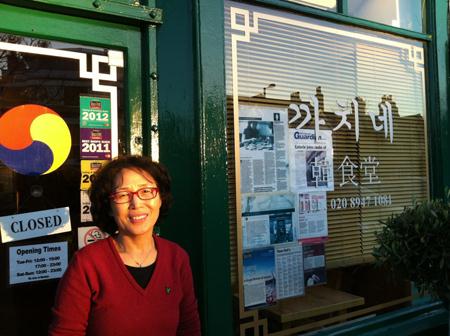
Hyeon-ja Jo, a 25-year resident of the U.K., stands outside her restaurant Cah Chi in the Raynes Park area of Greater London. (Photos courtesy of Niels Footman)

Hyeon-ja Jo, a 25-year resident of the U.K., stands outside her restaurant Cah Chi in the Raynes Park area of Greater London. (Photos courtesy of Niels Footman)

“For 13 years I had a virtual monopoly on ‘sundae’ in the U.K.,” she says, thus ensuring a steady stream of home-sick Koreans hungry for the pungent blood sausage. Today, however, thanks to Korean food’s growing profile and a spot for Jo’s restaurant, Cah Chi, on the prestigious Time Out list of London’s top 50 restaurants, so many Brits visit on weekends that “you wouldn’t even know it’s a Korean restaurant.”

While the longevity of Jo’s stay may be unusual, her status as an expat Korean in the U.K. no longer is. Britain is now home to somewhere between 22,000 and 40,000 South Koreans, depending on your source. Of that number, a sizable chunk live in England’s southeast, with as many as 15,000 residing in or around a single, otherwise unremarkable town in London’s suburbs: New Malden.

Surprisingly, given its decidedly low profile in comparison with Koreatowns elsewhere, New Malden is now reckoned to be the largest Korean community in Europe, with roots stretching back almost 60 years. Though its origins as a Korean enclave are hazy, Winny Yoon, who works at the Korean Residents Society (KRS), says that New Malden initially attracted Korean residents due to its proximity to Wimbledon, where the early South Korean ambassadors lived. Next came big Korean companies and their managers, followed by seconded staff, adventurers and entrepreneurs, and a steady stream of students.

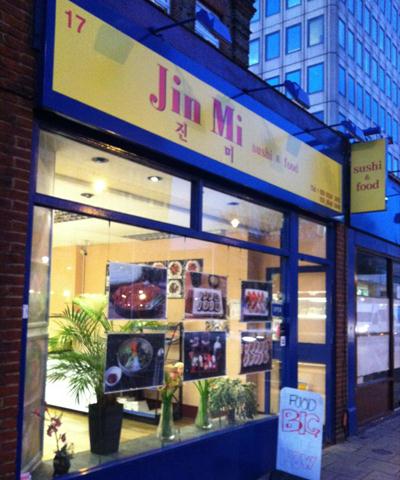
Jin Mi, on New Malden High Street, is one of the many eateries catering to New Malden's large community of Korean expatriates.

Jin Mi, on New Malden High Street, is one of the many eateries catering to New Malden’s large community of Korean expatriates.

Today, New Malden is a distinctly London-esque type of oddity: a little slice of a far-off culture, slotted right in among the trappings of Britishness. On New Malden High Street, amid the obligatory Greggs bakery and Tesco and Waitrose supermarkets, are restaurants with names like Asadal and Sorabol, a Park Jun Beauty Lab, a noraebang (karaoke) and, of course, a smattering of hagwon (educational institutes). Nor is New Malden’s embrace of Korea restricted to the southern half of the peninsula: According to Yoon, many of the shops and restaurants there are staffed by some of the estimated 2,000 or so North Koreans to have gained refugee status in the U.K.

For all its growth over the last two decades, New Malden and the Korean community remain newer and less entrenched than much of the Korean diaspora elsewhere in the world. However, a significant number of Koreans are choosing to come to the U.K. of their own volition, or elect to stay here once they’ve arrived.

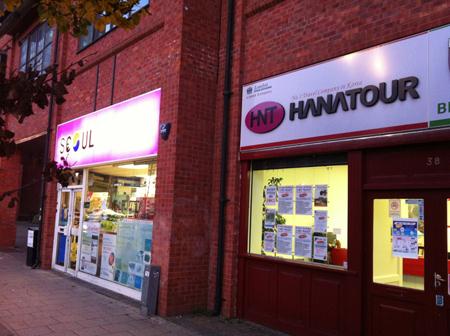
A common sight in Korea but rather less in the U.K.: a branch of the HanaTour travel agency in New Malden

A common sight in Korea but rather less in the U.K.: a branch of the HanaTour travel agency in New Malden

Mijeong Cho came to England 12 years ago with her husband, who was working for the elevator company OTIS. Her husband now runs his own removal company, catering largely to Koreans, which has suffered of late thanks largely to tightened visa laws stemming the arrival of new immigrants. But Cho has no plans to leave, and is now applying for a British passport.

“I like living here, but we’re here mainly for our kids’ education,” she says. “It’s a big thing for me as a mum knowing that my kids aren’t stressed at school.”

Housewife Jeong-yeon Choi agrees. “In Korea, competition is so severe, but in the U.K., there isn’t any competition,” she says, in a statement that will surely come as a surprise to British mums. “It’s great that children can just learn naturally.”

However long Korean immigrants stay, life in the U.K. is not without its challenges. Complaints abound of officious bureaucracy — especially regarding business regulations — and poor or just painfully slow service. “If you order a bed in Britain, it can take six weeks. In Korea, it’d take 30 minutes,” says restaurant owner Jo.

Above all, though, is the vexed issue of communication.

Two years ago, at a meeting of the Kingston Racial Equality Council (New Malden is located in the borough of Kingston), the incumbent member of parliament Ed Davey said that because much of the Korean population is transitory, “they feel less of a need to integrate and are not as open. That is a challenge for us.” His Conservative Party challenger, Helen Whateley, added: “People on the doorstep express quite a lot of resentment about some of (the Koreans) because they have not learned English.”

While acknowledging their difficulties mastering English — Jo, despite her many years in the U.K., still speaks of her “horror” at speaking English — Koreans living in the area have their own take on the obstacles to integration.

“It’s not easy to get along with British because they don’t open themselves up,” says Misun Jang, who teaches art history classes at the Korean Community Center in Raynes Park, near New Malden. “I think English women can be quite moody and British men don’t show themselves.”

“Koreans in New Malden would like to integrate, but they don’t know the laws well,” adds Jo. “And because we’re immigrants, our jobs aren’t great and life is busy, so it can be tough integrating.”

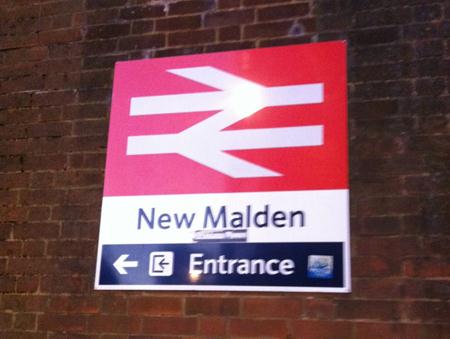
Located in southwest London, New Malden is increasingly known as the epicenter of Korean life in the U.K.

Located in southwest London, New Malden is increasingly known as the epicenter of Korean life in the U.K.

“Some other nationalities get heavy government support, but Koreans don’t like to ask for support: we are too proud,” suggests Yoon from the KRS. “We are now trying to break down these barriers with local groups, so we’ll see.”

Despite the misconceptions, U.K.-based Koreans such as Yoon seem to believe that British people are — thanks to football stars such as Ji-sung Park and the growing profile of Korean food and products — growing somewhat more aware of their culture. And for a small but growing cohort of immigrant Koreans, Britain, and especially New Malden, is moving beyond being a career step, a place of study or a tourist destination, and becoming, simply, home.

“New Malden’s homey and comfortable for me, and my house is there, too,” says Jo. “It can be a little limited for youngsters — everyone knows everyone else, so they have to watch what they do. But for oldies like me, it’s just right.”

nielsfootman@gmail.com
(END)

Posted in Yonhap | Leave a comment

Foreign Office minister Hugo Swire’s speech at AKS dinner 22 Nov 2012

http://www.fco.gov.uk/en/news/latest-news/?view=Speech&id=838187482
CHECK AGAINST DELIVERY

Thank you Warwick for that introduction. I would also like to thank Baroness Perry, who is the reason we are able to meet here in Parliament.
It is a great pleasure to speak to you this evening, so soon after my visit to South Korea. It was a real thrill to set foot in Korea for the first time, and to do so as we prepare to mark 130 years of diplomatic relations.

The bonds between our two countries are longstanding–something I was reminded of recently when I heard of the Korean War Veterans Association’s campaign to commission a war memorial here in Britain, which I am sure everyone in this room would support.

Over the past few decades the Republic of Korea has transformed itself. You have become the world’s twelfth-largest economy and a member of the G20; the first nation to transition from aid recipient to membership of the OECD Donors Assistance Committee.

You are an economic miracle, a thriving democracy and a growing voice for good in the world today.

It is these characteristics that make it so important for Britain to build a strategic partnership with Korea – one in which we work together, across the board, to achieve our common goals.

We are, of course, watching the build-up to the Presidential elections with interest. It seems it will be a close contest. But regardless of who wins on 19 December, we look forward to continuing our close relationship with the new Korean government.

In the next few minutes I want to explain what we have done over the past year to consolidate and build our strategic partnership, but also to consider what more we need to do.

A new chapter in relations

The last twelve months have seen an unprecedented stepping up of co-operation between the United Kingdom and Korea.

We have deployed more diplomatic staff in Seoul, and British Ministers are visiting more frequently.

The Deputy Prime Minister, Nick Clegg, visited Korea in March, with Jeremy Browne following two months later. The then-Defence Minister Peter Luff was in Seoul in June; Energy and Climate Change Minister Greg Barker in October; and Lord Howell, the Foreign Secretary’s personal adviser on energy and resource security, just last week. Korea was the first Asian country that I visited as a Foreign and Commonwealth Office Minister.

And we have hosted several high-profile Korean visitors here in London, including Trade Minister Bark, Deputy Minister for Political Affairs Kim Kyou-hyun, your Six Party Talks representative Lim Sung Nam, and senior politicians Sohn Hak-kyu and KIM Moon Soo.

These expanded contacts have helped us to drive forward our relationship like never before.

The Host-to-Host agreement we signed in March is increasing commercial co-operation ahead of the 2014 Asian Games in Incheon, the 2015 World Student Games in Gwangju, and the Pyeongchang Winter Olympics in 2018. British company Populous designed the main stadium for the Asian Games, and others such as Colt are plugged into the Incheon supply chain. The success of the London 2012 Olympic and Paralympic Games has left us well-placed to share our experience and to win contracts.

On defence, we announced in March that Korean Daewoo Ship and Maritime Engineering would build four new tankers for the Royal Navy, a deal worth £460 million. Shortly afterwards Korea announced that Rolls Royce would supply engines for the next generation of Korean frigates, worth $120 million. We hope to continue to expand this relationship.

In June we launched our joint Youth Mobility Scheme, an initiative which in 2013 will enable up to 1000 young people from Korea to live and work in the UK for up to two years. It grants the same rights to British young people, an opportunity I sincerely hope many will take advantage of.

And during my visit, I met some new North Korean settlers benefitting from our ‘English for the Future’ programme, which is helping to develop the English language skills they need to compete in today’s jobs market.

But I believe we can do more.

Scope to do more on security

Working together to tackle pressing international problems should be a high priority.

This month’s inaugural UK-Korea Strategic Dialogue, which I was pleased to attend the opening of, provided an excellent vehicle to begin this. It was also very timely, as Korea prepares to take its seat on the UN Security Council next year.

Central to our discussions were Security Council priorities such as the Middle East Peace Process, Syria, Iran and, of course, North Korea – on which I believe Britain can offer a valuable insight, given our presence in Pyongyang. Over the next year, I will be taking a personal interest in ensuring that the UK works closely with Korea to progress our common concerns.

However, to have a truly strategic relationship we need to look beyond these immediate priorities to the issues that will affect us in the longer-term.

Climate change is perhaps the most important of these. By spending two percent of GDP on green growth every year for the past four years; by putting in place domestically-binding emissions targets; and by becoming the first Asian country to pass emissions trading legislation, Korea is showing strong regional leadership

Add to this your winning bid to host the Green Climate Fund, and the successful launch of Global Green Growth Institute, and it is clear that you are not just regional leaders on climate change – you are global leaders. New Song Do will be an excellent location for the Green Climate Fund, and I am delighted that Britain will take on the role of Vice President of the Global Green Growth Institute Assembly.

But there are other issues to focus on too. I strongly believe that South Korea can be a powerful voice on human rights, for example – in its neighbourhood and beyond.

We have a shared commitment to international peacekeeping, having both contributed to efforts in Afghanistan, Lebanon, Haiti and the Horn of Africa. The Korean National Assembly’s recent decision to deploy a contingent of military engineers to South Sudan is welcome. I hope that Korea will continue to expand its efforts in this area.

The UK and Korea are active international donors, so we have a shared interest in ensuring that aid is used effectively. Korea is uniquely placed, given its own experience of development, to play a key role in the dialogue between developing and donor countries to help us achieve this.

We should also work more closely on cyber security. It will not be easy to find an international consensus on rules of the road to guide future behaviour in cyberspace, and to combat the worst abuses of it. But the active engagement of countries like yours will help to take us a step closer. We are looking forward to the cyber conference in Korea next year.

Closer partners for prosperity

On the prosperity agenda, too, we have much to gain from closer co-operation.

I returned from Korea last month fascinated by the sheer dynamism of its economy. I am keen to make more British companies excited by the opportunities this dynamism creates – especially new exporters and SMEs.

With that in mind, I am pleased that next February, UK Trade and Investment will run a week-long series of events across Britain, ‘Opportunity Korea’, aiming to do just that. British companies are already coming on board and I am personally keen to play a part in ensuring its success.

Nevertheless, we need your help to spread the message that Korea is a place with opportunities worth exploring. I would encourage businesses here today with experience of Korea to get involved.

The EU-Korea Free Trade Agreement could also provide a significant boost to our commercial relationship. Of course, it needs to be implemented in a way that does not harm business, but if we get it right it could add £49 billion to EU Korea bilateral trade over the next 20 years.

A common understanding

As we work more together, our countries are also developing a greater common understanding. That is important because, like any relationship, you work best together when you know each other.

At the start of this year, our Embassy in Seoul commissioned a survey of Korean views of the UK. There were some hugely positive messages to come out of this – not least that participants between the ages of 18 and 30 identified Britain as their favourite overseas country. The enthusiasm for the UK – a genuine warmth I felt when I visited – was clear to see.

Unsurprisingly, the survey also brought out traditional themes. People identified Britain as a “nation of gentlemen” – with grand architecture, a Royal Family and dreary weather. English football’s Premier League also made an appearance, as did Harry Potter.

However, the stereotype extended into slightly more unhelpful territory. That behind our castle walls, we Brits are technophobes lacking in creativity and ideas.

London 2012 started to challenge these perceptions, showing what today’s Britain is really like: diverse, open, connected, creative, dynamic. I know that message was not lost on our Korean friends.

And shortly after the international spotlight had been fixed on the UK, it shifted quickly East – to Korea, to Seoul, and, ultimately, to Gangnam.

I am talking, of course, about K-pop sensation ‘Psy’, whose “Gangnam Style” has taken the world, and Britain, by storm.

People across the globe – from members of our Royal Family to the UN Secretary General – have been embracing the rapper’s equestrian dance moves. You will be relieved to hear that I will not be inflicting my own rendition upon you this evening.

But being serious for a moment, I think that Psy’s music has given the world, and people here in Britain, a glimpse of the dynamism and vibrancy of modern Korea. It has shown a nation of colour, creativity and confidence.

And so I would like to end today by saying that I see Psy’s success as representing just one small fragment of today’s Global Korea.

You are already a world leader in the business world, with companies like Hyundai, Kia, LG and Samsung, household names. As “Gangnam Style” has demonstrated, your music is global too.

But it should not stop there, and I don’t think it will. With your membership of the G20, your forthcoming role on the UN Security Council and your leadership on issues like climate change – you are becoming a truly global nation in the political sphere.

As you look to the years ahead, I hope you will view Britain as one of your closest partners. I am sure that the Anglo-Korean Society will help to ensure that you do.

Posted in Uncategorized | Leave a comment

The Good Parts To Life In North Korea

http://www.nknews.org/2012/10/the-good-parts-to-life-in-north-korea-2/

Question: Was there anything good or positive about living in North Korea? All we hear about are the bad things. Do any of the DPRK’s citizens benefit from the state?

Maxwell B.

Jae-young: Although media and news only show negative aspects to life in North Korea, there are actually positive and good aspects about life in the DPRK. Of course there are differences between individuals, but compared to my current life in the South, life in North was mentally rich – even if it was materially insufficient. The reason for this is because of the pure heart and affection of North Koreans. Here, in South Korea, there are lots of people with affection, but in North Korea, especially in rural areas, affection between neighbors is very pure and deep.

In North Korea, on birthdays and national holidays, families and neighbors gather and share with each other. My mother used to cook a lot and share food with neighbors. She didn’t have to cook a lot for my family, but because neighbors had a lot of family members, she had to cook a lot. Even though she had to wake up early and cook, she never refused. I used to wake up early and help my mother. On major holidays, we invited our neighbors (we used to call my mother’s friends “aunt”), shared food and stories with them. My mom was really good at making ‘Jong-Pyun rice cake’ and I can still remember my aunts exclaiming how good they tasted. During nights, we gathered together, turned music on and danced. On days when electricity went out, we used to play the accordion, sing, dance and have fun. I used to have so much fun and danced so hard that my socks had holes when I checked them in morning. My father used to be respected as a gagman (comedian). Also on national holidays, North Koreans visit their parents, teachers and alumnus. In South Korea, people do the same, but I think it was deeper in North.

Moreover, North Korea’s excellent natural environment is another nice aspect of life in North Korea. Air in North Korea is very fresh. In spring and fall, my school used to go on field trips. Every year, we went to a cool valley. Water was very fresh and lots of flowers were in bloom. For the whole day, we played scavenger hunt, swam, then ate packed lunch, cooked by my mother. I bragged about how my lunch tastes better than others’. After lunch, we had talent shows. I remember bragging about earning prizes for my skills and getting praised.

Although from a material perspective things were often lacking, I sometimes miss the pure heart and sharing affection so common to my life in North Korea.

To the second part of your question… In North Korea, although it isn’t common, there are some ordinary people who receive gifts directly from the state. Some people earn the “hero” title and receive televisions and other goods. These people get better gifts than other people on national holidays. But there aren’t many of these people – I rarely saw a “hero” in my town. There was one, but he didn’t get as many benefits as other “heroes”. Really, the main people who really get benefits from the government are civil servants, such as party officers, police officers, government agents and few other people. These are the people who get to live with consistent privileges and get to live an easy life.

On the other hand, benefits that common people get include free health care and education. Schools are free. Unlike in South Korea, if a student falls behind, teachers help them after school hours. Moreover, students who are good at school work to help other students. In addition, if a student wants to learn how to play an instrument or certain sports, they can learn for free. I used to learn how to play the guitar and accordion. I also think that I didn’t have to pay for books. However, the government didn’t pay for them either. But because the government didn’t provide enough funds for books and uniforms, my teacher gave them to us, according to our grades. I had a friend who was mad at the teacher for not giving him books, because his grades weren’t good enough. Our predecessors gave us books and we gave them to our successors. That’s why we used them as carefully as we could and studied as hard as we could. Because of that, I still can’t write or draw on books. Education is free in North Korea, but lots of people had to buy books and uniforms by themselves.

Health care was free as well. According to an acquaintance of mine, she gave birth in a maternity hospital for free. I didn’t have to pay for treatment either. Operations, checkups and medicines were free as well, but lots of people had to pay, since this was in theory only. Lots of state provisions for common people were in theory only, so people had to pay for them.

Everything was suffocating and pitiful in North Korea, but it is a country that I have many positive memories from. So if someone asks me ‘What is North Korea like?’ then I say ‘North Korea is a nice place with plenty of love.’

Posted in Uncategorized | Tagged | Leave a comment

South Korean host bars – for women

http://www.bbc.co.uk/news/magazine-19570750

Red Model Bar

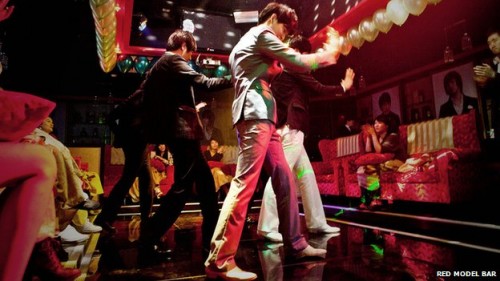
South Korea’s rapid economic development has meant some startling changes within its conservative social structure, including the rise of so-called host bars, where wealthy women pay the equivalent of thousands of dollars for male company.

In the dim light of an underground room, a dozen perfectly groomed young men kneel in rows, calling out their names.

Muscular, with shiny boy-band hairstyles, they cram side by side into the narrow space, waiting for us to make our choice. Outside in the corridor, more of their colleagues are arriving for another night at work. It is 2am, and we are their first customers.

Hidden beneath the pavements of Seoul’s ritziest postcode, Gangnam, the men at Bar 123 are part of a growing industry, which grew out of the long traditions of Japanese geisha and Korea’s kisaeng houses but with one crucial difference – the customers here are all women.

Known as “host bars”, these all-night drinking rooms offer female customers the chance to select and pay for male companions, sometimes at a cost of thousands of pounds a night.

One of the women I meet at Bar 123 is Minkyoung, a waitressing manager for a five-star hotel. She says she comes to host bars once or twice a month.

Minkyoung is very pretty and her clothes are immaculate. She does not look like someone who would need to pay for male company. But the allure of host bars can be subtle. Here, she says, she has more attention from her male companions, more choice and, crucially, more control.

“In regular bars the guys who drink with me have only one goal – to have a one-night stand. But I don’t want that, so that’s why I come here, I want to have fun,” she says.

Hosts are hired by bars like this one to provide companionship and entertainment. Officially that means pouring drinks for their customers, talking and dancing with them, and singing karaoke.

Sex is not officially on offer in most host bars. That would be illegal but even Minkyoung seems happy to touch and flirt with her host, and the men here estimate that around half the customers want to pay for sex, either on or off the premises.

James has been working at Bar 123 for a couple of years. In Korean culture, he says, there is a lot of pride and negotiating a price for sex is never done explicitly. Instead, he tells me, it is all down to the host’s own assessment.

“The guys here are pros – we know what we’re doing,” he says.

“After talking to a girl for an hour we basically know how much money she makes and what she does for a living. We’ve already analysed her personality and what she’s willing to give.”

James and other hosts say their customers include some of South Korea’s elite, and that the money and perks on offer are unbelievable. One client James met, during his first week in the job, asked him to sign himself over to her for two years.

“She said ‘let’s make a contract. I’ve got this piece of paper and I’ve numbered it 1-5. Whatever you write down next to those numbers, I’ll get you.'”

James says at the time he took it as a joke but since found out the same woman spent £60,000 ($97,000) on another host.

“If it happened now, I’d do it – I’d be thinking straight.”

Ironically perhaps, host bars grew out of one of Korea’s most entrenched and, some say, misogynist business traditions – the room salon. These are private drinking rooms where groups of men select, and are served by, attractive female hostesses.

It was the hostesses’ need to let off steam after work, says veteran host Kim Dong-hee, that created the initial demand for host bars, with all-male staff.

“What these hostesses want is to [make us] do the same thing they had to do in their own workplace. These girls are forced to do things they don’t want to do for money.

“I think a lot of them are in pain, and a lot feel lonely. Simply put, they want to buy our time and our bodies.”

Hostesses still make up a large percentage of the customers at host bars here, but at Bar 123, for example, up to 40% of the customers on a given night are now from other walks of life.

The reasons for that growing appeal are tied up in South Korea’s rapid economic rise. Within 50 years, the country shifted from post-war devastation to OECD member.

But, according to Jasper Kim, head of the Asia-Pacific Global Research Group in Seoul, something important was lost along the way.

“I think that with all this fast growth comes fast change, and Koreans just don’t know how to cope with it. Increasingly, capitalism is overtaking basic societal norms that you would expect a couple of decades ago.”

Jasper Kim says South Korea’s notoriously long working hours have left many Korean women feeling lonely, while the country’s technical advance has left many people feeling detached.

“The human element of Korean society that existed before simply doesn’t exist today. People are focused on technology, people are focused on their jobs, they aren’t focused on human relations anymore.

“In many ways, Korean society today kind of reminds me of 1960s society in the US, where it’s on the verge of some type of cultural revolution.”

The grandfather of Seoul’s host bar scene, Kim Dong-hee, agrees that many of the women who come to host bars are not paying for sex but for companionship, which is why he opened a new chain of freshly-marketed outlets aimed at the mainstream market – called Red Model Bars.

“Men want to have visual pleasure and want to feel things, they’re tactile. Women like to talk and to listen. And that’s why I thought of opening a bar like this – a kind of dialogue bar.”

Red Model Bars are different to traditional host bars in one key respect – there is a no-touching rule. Hosts sit on one side of the table, customers on the other, and no physical contact is allowed, and certainly no sex.

Perhaps as a result there is a lack of furtiveness among the people who work or drink here – the lights are low, the decor mainly dark red and the space is divided into discreet booths, but it is an open-plan room and hosts and customers are divided in each booth by a large table.

This new business model depends entirely on women paying the equivalent of hundreds or even thousands of dollars to talk to good-looking young men over a drink. Still, it seems to be working – three new branches are due to open this year.

Sitting at a table at one end of the bar was one of their regular customers, a florist called Kim Nayu. She tells me she comes here every day to meet her favourite host and discuss issues she is having at work.

The price for this slice of male attention is $487-650 (£300-400) a day.

“Talking to friends would be cheaper” she admits, “but they don’t listen as much. They’re busy, and in a hurry to talk about themselves. Here, people will pay attention to me and they’ll listen to me.”

“I spend a lot of money but it’s worth it for what I get emotionally. People pay to go to see a psychologist or psychiatrist, so it’s similar but less stressful.”

Nayu’s favourite host Sung-il says it can be hard to keep his personal and professional life separate.

“Honestly I’d be lying if I say I haven’t been tempted to take things further with some customers, because we’re human, we’re men, but there are rules.”

One of his customers talked a lot to her husband about him and when the three of them met, Sung-il and the husband became close friends.

“No one hides – the workers don’t hide that they work here, and customers can be open too.”

This openness is posing a new kind of challenge to South Korean society, different from the sometimes seedy underworld of traditional host bars and their hinterland of male prostitution.

By offering women a “respectable” way to challenge traditional gender roles and flex their economic power, these new bars ask questions of Korean society that are becoming harder to ignore.

Posted in BBC, Lucy Williamson | Leave a comment

Hwang Ji-hae: “I get inspirations from the gardens I saw while growing up.”

Hwang Ji-hae: “I get inspirations from the gardens I saw while growing up.”
http://www.koreafocus.or.kr/design2/layout/content_print.asp?group_id=104282

Kim Yun-deok
Staff Reporter
The Chosun Ilbo

“Can you make me look attractive to investors?” Everyone laughs when Hwang Ji-hae (Jihae Hwang), 36, the “queen of the Chelsea Flower Show,” makes this odd request as she poses for the camera. But it is understandable, considering the anguish money has caused her this year. Though she has won a gold medal two years in a row at the world’s most prestigious garden show, she has fallen into debt. “Participating in the flower show twice has cost me my car and my house,” she says with a laugh.
 
“Quiet Time: DMZ Forbidden Garden,” her entry for this year won the Royal Horticultural Society President’s Award, the highest honor in the Show Garden division (for gardens covering 200m²) of the Chelsea Flower Show, held in May in London, but it almost did not come into being. Three weeks before the show was set to open, when the garden was about 40 percent complete, Hwang realized that she did not have enough money to continue. But like a miracle, two construction companies from her home province of Jeolla in Korea came forward as patrons. British visitors to the “DMZ Forbidden Garden” were duly impressed with the treasure trove of plants that have paradoxically survived thanks to the division of the country after the Korean War. Some of the more famous visitors to the garden were Prince Phillip, Princess Anne, and fashion designer Paul Smith.

We met Hwang when she returned to Korea to participate in the Gwangju Biennale. Tanned and wearing leather boots, she looked as if she had just been planting a couple of trees. “It’s not the sun’s fault,” she says. “I’ve always been dark skinned. I must have been born with a spade in my hands.” (laughs)

The Queen of Chelsea in Debt

Q. So you mean the star of the Chelsea Flower Show has fallen into debt.

A. My family home was already mortgaged when I won a gold medal in the 2011 show with “Hae-woo-so: Emptying One’s Mind” in the Artisan Garden division (small garden of 20m²). My younger brother, who looks after the family books, is very upset with me. (laughs) I poured more than 200 million won into this year’s garden, “DMZ.” The remaining 500 million won came from two construction companies in the Honam region, Hoban Construction and Namkwang Engineering & Construction, which gave 300 million and 200 million won, respectively. The economy’s not good right now, so I was just very grateful. As I am a Honam native, the city of Gwangju also helped me. When I came home a month ago I was busy going around visiting all the people I am indebted to.

Q. Is the Chelsea Flower Show so important that it’s worth going into debt?

A. The Chelsea Flower Show began in 1827 and is the biggest show of its kind in the world. A royal event organized by the Royal Horticultural Society (RHS), it is the dream of all garden designers. I learned about the show 10 years ago. I had been active as an environmental artist and always had a thirst for nature. When I saw the Chelsea show, I was convinced that a garden was the perfect medium for fusing nature and art. Vaguely I believed I would do well, and it seems it was fate. How can I put it? It was like meeting a long forgotten first love again.

Q. You received gold medals for both your first and second entries in the flower show, even though you were a newcomer.

A. To prepare for the show I first went to stay in London in 2007. At first, I didn’t even dream about entering. I wanted to build my skills first and set out to apply to the faculty of garden design at the Inchbald School of Design. But one day the vision of a traditional Korean toilet, haewooso, came to me. Not because I’m particularly patriotic. But I was lonely and tired in a foreign country where I didn’t speak the language, and I kept looking back on myself, wondering who I was. I realized we didn’t need to envy the formal gardens of Europe, and found myself remembering the natural gardens that I saw while I was growing up. I recalled the night stars I saw on my way to the outhouse at night, the breezes at dawn, and the smell of the earth. It was now or never, I thought, so I gave up the idea of going to school and sent my design plans to the Chelsea Flower Show.

Q. What are the judging procedures?

A. First you have to submit to the RHS your landscaping blueprints, gardening plans, drawings, and 3D images that show what the garden will look like. If you make it to the second round, you are judged on the rarity of the plants chosen, and the artistry of the design. Receiving a notification on site allocation means you’ve made it to the third and final round.

A. For the DMZ garden you were allotted the site in front of the Queen’s Garden, which is the highlight of the Chelsea Flower Show.

A. It was a difficult site, triangular in shape and open on all three sides. It was a little daunting to be under the spotlight next to the Queen’s Garden, but I took the site allocation as recognition of the quality of my design, which gave me confidence. The DMZ garden aroused a lot of interest in the first two rounds of judging.

Q. The work must have been difficult considering the great size of the site.

A. The garden required native plants from home to be brought to London, so freight costs were three times higher than usual, and getting them through customs was also an ordeal. There are no specialist garden construction companies in Korea so our team did all the work ourselves. We had to make all the flowers bloom at the same time for the opening of the show on May 20, and we ran our feet off taking care of 10,000 plants at the same time. And our funds had run dry.

Q. I can imagine the RHS would have been disappointed if you had given up on your garden due to lack of funds.

A. That’s not the case. The RHS has held successful shows for 185 years. It makes thorough preparations, and if I had given up another team would have been ready to replace me right away. Lots of artists were probably waiting for me to give up. Three weeks before the opening, when the notice came asking me to sign forfeiture papers, I exhausted myself with anxiety until I felt blank. When I emptied my mind and resigned myself to the situation, a miracle happened. (laughs)

Changing Trends in Garden Design

“Quiet Time: DMZ Forbidden Garden,” comprised of 10,000 plants of 300 species, is not a neat, pretty garden. The grass and trees seem to grow haphazardly and are not trimmed to any particular size. “Instead of prestige trees and flowers, I planted wildflowers. Sixty percent are indigenous Korean plants,” says Hwang. “I planted mugwort, which our soldiers used to stop bleeding; plantain, which was squeezed for juice to treat stomachache; and plants that could be used for food such as wild grapes, hardy kiwi, shepherd’s purse, and dandelions.” The high watchtower and barbed wire that runs around the garden are reminders of the war. Bottles containing letters from separated families, a path paved with thousands of uniform buttons, and a bench made with the ID tags of 8,000 British veterans of the Korean War… A stream runs through the middle of the garden.

Elizabeth Banks, president of the RHS, praised the garden, saying it was the most profoundly moving garden she had seen in her life. The Times introduced it as a garden featuring a watchtower and barbed wire and the most original that the queen would see this year, while the Guardian said the weeds had become jewels. In addition, a British gardening magazine said that the messages of reconciliation and healing in the DMZ garden made all the other gardens pale into pretty insignificance.

Q. Both the Hae-woo-so and DMZ gardens are filled with nameless wild grasses and wildflowers.

A. I was born in the countryside, so I’m not used to roses and lilies. The only ones I saw were in the school flowerbeds. The fields where I played were covered with wildflowers like river bulrushes, touch-me-nots, burnets, and the smartweeds called myeoneuri mitsitgae [daughter-in-law’s toilet paper]. Nobody cares about the wildflowers, but when they are planted together in clumps they are really beautiful. I love their lines and shapes, their clear colors.

Q. What is it about the DMZ garden that moves people?

A. As everyone knows, Europe is having a hard time right now. It’s not only the economy; the people are also exhausted. In Europe gardening is an upper class pastime. In the way they change their brand name clothes every season, the rich newly decorate their gardens every season with expensive plants and flowers. At the Chelsea Flower Show also there has been a preference for gardens featuring rare plants, newly developed species, and beautiful luxurious flowers and trees. But Korean gardens like “Hae-woo-so” and “DMZ” shook them up. They were astonished by the simplicity and roughness of the Korean garden, which was nevertheless overflowing with life and energy. The Europeans, who cringe at the word “toilet,” discovered in it truthful stories about real life.

Q. So you’ve changed the trend of European gardens?

A. The garden that won the gold medal for best show garden this year in the Hampton Court Palace Flower Show, one of the three top flower shows in the world, was titled “Bridge over Troubled Waters.” It’s hard to say they were not influenced by the Hae-woo-so and DMZ gardens. When I submitted my blueprints to the Chelsea show, people scoffed at first. Bets were placed before the show and it was predicted that a pyramid garden for parties by British star designer Diramuid Gavin would be the favorite. But against expectations DMZ was the winner. People were moved by the simple spirit of the garden.

Q. Members of the royal family including Prince Phillip, Princess Anne and Prince Edward have visited the garden.

A. Prince Phillip thanked me and said it was an honor to see such a garden before he died. Paul Smith said it was fortunate both for himself and for England to have discovered Hwang Ji-hae. He was a very sexy and witty person. One other visitor said that standing in the garden made him feel a sense of peace. When one of the volunteers who helped make the garden said “I’m eating food for the soul,” I almost burst into tears.

Q. I hear that some Korean War vets also played a part in completing the DMZ garden.

A. When the garden was in danger of being discontinued, they wrote a letter to Queen Elizabeth and to our presidential office, Cheong Wa Dae. They hoped to see the garden completed to ensure that the Korean War did not end up being a forgotten war. Many of them wept when they came to visit the garden at the show.

Strength from Deficiency

In the garden design and landscaping world, Hwang Ji-hae belongs to the minority. A graduate of Mokpo University where she studied Western painting, Hwang was active for a long time in the Gwangju area as an environmental artist. Her artistic inspiration comes from her childhood in the country town of Gokseong and her mother, who was a typical country woman. “When I design gardens I always think of my mother,” she says.

Q. Did you show artistic talent as a child?

A. Drawing was the only thing I did well as a child. In our poor country neighborhood my mother was the only one with a real passion to see her children educated, so I often used the whole art room in my school by myself. (laughs)

Q. What kind of person was your mother?

A. She was a tough person who had to raise three children on her own and made a living by running a restaurant and a hair salon. But she was also a woman who on windy days would take a chair out into the yard and close her eyes to enjoy the wind. She had great sensitivity to such things, unlike most country women. She knew how to use nature to deal with the fire in her heart. She gave me my name Ji-hae, which means “wise sea.”

Q. You majored in painting, so how is that you’ve found success as a garden designer?

A. The kitchen garden that my mother cultivated was my first garden and my treasure trove. The garden had all kinds of fruits and vegetables growing in it, so many that there are few fruits that I have not tasted. I would play in the garden and fall asleep there, and was constantly bitten by insects. My childhood of playing in the fields is my source of inspiration and energy. Once I decide on the theme, it’s easy for me to see which plants will look most natural in the garden.

Q. A lot of people are surprised that the star of the Chelsea Flower Show is from a provincial university.

A. I wanted to attend an art college in Seoul but I didn’t get in. I’m the kind of person who doesn’t like to take any steps backward, even drive in reverse, so instead of repeating I decided to attend a university close to home. But there were a lot of excellent professors there who gave us experience in a lot of different genres. My experience with gardens in university, which called for a variety of skills and even made me want to get a driver’s license for heavy equipment, laid the ground for my current work.

Q. Can you tell us about Muum, the environmental art group that you formed?

A. My eyes were opened to environmental art thanks to a professor who had studied the subject in Paris. When I was a student teacher, I once painted a mural at a country school. When I saw the children clapping and jumping with joy, I decided to form a group of volunteers and we went around painting murals at country schools and medical centers. That was the start of Muum.

Q. Why the name Muum?

A. The look of the name [뮴 in Korean] is artistic! (laughs) There is no special meaning. If you look at the word, it looks like a person sitting with knees bent. From childhood I liked to see my mother praying on bended knee. Although it’s a local artists’ group we have worked not only in the whole Honam region but also in Seoul. We’ve also done a whole lot of apartment complex landscaping work, though we were only subcontractors.

Q. Do you think you would have found sponsors more easily if you had come from an elite university?

A. I don’t know. But I do know that my drive for life comes from deficiency, from my complexes. (laughs)

Q. I hear you are planning to enter the Gardening World Cup at Huis Ten Bosch in Nagasaki, Japan this September.

A. I have been getting a lot of calls since I won an award at the Chelsea show. The world’s top 10 garden designers are invited to the World Cup, so it is a great honor, but to tell the truth, I’m very tired.

Q. Are you planning to enter the Chelsea Flower Show again next year?

A. No. The experience this year was so hellish I don’t think I’ll be returning next year. (laughs) If no corporate or government sponsor appears and offers to help first, then definitely not. Ha-ha!
[September 8, 2012]

Posted in Art and Culture | Leave a comment